Thursday, March 31, 2011

The Last Taboo


The subject of death is, in some respects, our society's last great taboo.We feel free to talk about sex, drugs, finances, politics, etc., but death is still somewhat on the fringe. Why is that? I think it has to do with a fear of dying and the fact that we can't change it no matter how many revolutions there are. For example, when the feminist movement was at it's height, there were rallies in the streets, protests on every corner, and huge amounts of discourse in the media. And things changed. But with the subject of death, no matter how many people are against it, or how many letters are written to the government, it will never go away. Sure, medical advancements are keeping us alive longer and longer, but at this point death is still inevitable.


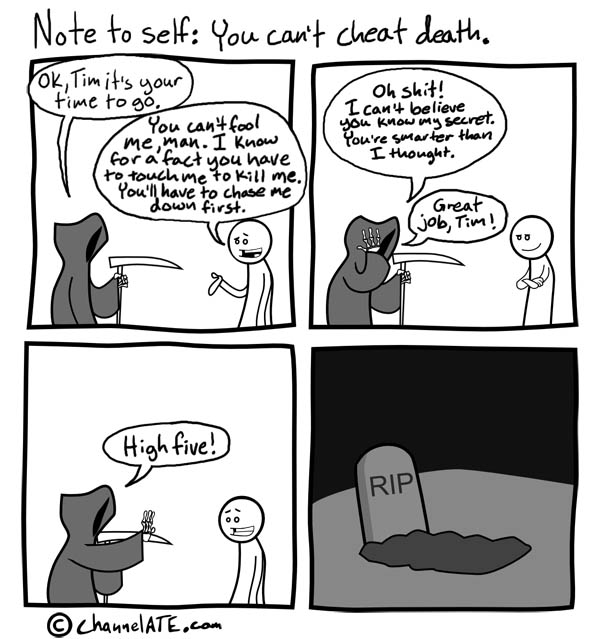
Cheating Death. High 5!
Death is inevitable!
www.lolzombie.com

So we don't have any control over death and that's scary. I get that, but I still think there's more to it than that. We have absolutely no idea of what happens to us after life, and that's a terrifying idea to a lot of people. Do we go to a heaven or hell? Are our souls freed to float through the world? Or do our bodies just rot in the ground and that's all there is to it? Nobody knows and we never will, but my thought on this is why does it matter? My big fear of death is missing the people I love or missing out on things I could have done during my lifetime. I'm not a religious person and I have no idea what happens after death, but I'm rather inclined to think that not much at all happens after we're in the ground. From my point of view, then, I won't be able to miss anything because, well, I'll be dead! Despite that, I'm still afraid of death, probably because I know that it would be very hard for all my friends and family. It saddens me to think what they will have to go through when I die because I know it's hard to lose someone.

Overall then, is our fear of death and the associated taboos irrational or totally reasonable? I think it's reasonable. Wondering how your loved ones will react is a fairly human worry, and even if you aren't around to feel the pain of missing people, you are well aware that the living you leave behind are. Also, it's a very sensitive topic and you never know what might trigger a sad memory for someone. So rather than tread on a friends' toes, we just stay away from it altogether. The other taboos are overcome, it's almost considered cool to discuss previously hush topics now, but I think death will remain taboo for some time to come - at least until we can figure out how to live forever!

Tuesday, March 29, 2011

Selective Memory

This is a photo I took of Victoria falls - see how I got lost in it?


In class today we discussed how we choose to remember the dead and how this is reflected in the monuments we build and the things we do to engage with the deceased. Sitting in class, listening to this, it struck me...I have selective memories of my grandmother. She passed away nearly 5 years ago, and while I remember her in the hospital and at her funeral, I chose to memorialize her differently for myself.

Between September 2008 and February 2009, I traveled in Africa. People always ask me why I chose to go there, rather than Europe, or India, or the more popular destinations for people my age. I'm always a bit stuck for an answer, but it's become more clear to me over the years - I went, in part, to follow my grandma. I went to Kenya and Tanzania when I was younger, and I absolutely fell in love with it. But I think the second time round, the choice to spend nearly 5 months there, was more than a simple revisit...Grandma loved Africa, and traveled there often. I have vivid memories of her telling me of her adventures on safari, of the people she met, and the sights she had seen, and I remember thinking "I want to go there, I want to be that". So after she passed away, I think the draw to go was stronger, in remembrance of her.

There is a particular moment I remember during my travels, where I felt her presence there with me, and I felt I was in the exact right place at that time. Sitting at the edge of Victoria falls, I had never felt closer to her. It was strange, because we were very close while she was alive. But sitting there quietly, it was like I had reconnected to something so dear to her, and I knew she would be proud of me. I knew she had been in that exact spot,  years earlier. I had seen the photos and heard the stories, and I was actually living it. She inspired me to go, and that trip has inspired so much of my life and goals. I think I have my grandma to thank for that.

This is getting very sappy, but in the space of a few minutes in class, all of this passed through my brain. The connection is there, I chose to remember my grandma as she was in her happiest days, living in the continent she loved so much. That is who she is to me, not a sick woman in a hospital bed. While I will remember her last few months like that, my connection will always be to her life.

Thursday, March 24, 2011

Middle-Class Egyptian


When I'm procrastinating, I quite often go to the National Geographic website and just browse around. Yes, I'm a big nerd, but it's fascinating stuff! Today, I decided to check out if there was anything new in the way of burials coming out of Egypt, and I came across an article describing the excavation of a middle-class official named Neferinpu. I don't know much about Egyptian burials, so I have only ever really been exposed to the burials, tombs, and pyramids of the Egyptian elites and rulers. I think this is pretty common, so I find it very interesting that a middle-class burial made it into National Geographic. According to the article, the location of the tomb itself had a lucky placement, keeping it safe from grave robbers. That is really exciting because it means that the grave has not been disturbed since the time of the burial, and everything is left just as it was originally placed.
Neferinpu: National Geographic
http://news.nationalgeographic.com/news/bigphotos/56287376.html

Neferinpu was buried with the staff that marks his office. He had several material goods placed with him, and he was clearly considered important enough to be placed in his own tomb. From the sounds of it, his grave is not spectacular, but is definitely indicative of some level of wealth and respect. I find this fascinating, because it's just a step down from the higher class burials we are used to hearing about. He has a tomb and grave goods, but it's just on a smaller scale to reflect his lower status.

So why don't we hear more about middle class burials? After all, the elites only make up a small portion of the population, yet that is all that seems to be in the news. Perhaps it's because these graves are more carefully prepared, so they preserve better. While that is probably an important factor, I think it has a lot to do with our modern obsession with "stuff". If there isn't anything rich or extraordinary in the grave, why should we care? It's just a bunch of old bones as far as most people are concerned. I can kind of understand this view, because if every grave was published, it would be never-ending. But I think that the importance of the bones, and the significance of the lack of extravagance is often overlooked. As I said before, the elites only make up a small portion of the population, and are therefore not really good indices of what life was really like for those people. We need a more in-depth analysis of the common, every-day person of the past to better understand our histories, and Neferinpu is a great start!

 Stanek, S., 2008. Rare Middle-Class Tomb Found in Ancient Egypt [Online] (Updated 18 January 2008) Available at: http://news.nationalgeographic.com/news/2008/01/080118-egypt-tomb.html [Accessed 24 March 2011].

Sunday, March 20, 2011

Our Funerary Customs

I had a very interesting conversation with friends over the weekend, and some odd topics came up. It might have been the beer talking, but a good friend of mine said that at his funeral he would like us to put him on marionette strings so he can "join in" the dancing and festivities to celebrate his life. We all laughed awkwardly for lack of a better reaction, and started to give him a hard time. It just seemed so preposterous and totally unacceptable. But it got me wondering...why, in our culture, are funerals grieving ceremonies to mourn a loss, rather than a celebration of a life well lived? I have several friends who want their favourite song played, a particular drink served, or a mandatory dance party to keep the mood light in remembrance. So why do we, as a culture, generally have a mourning ritual when a light-hearted party might be what the deceased themselves actually wanted?

I have heard, and fully believe, that grieving is necessary to get over a loss. But why grieve in public? A quick think back to what I have learned about funerary celebrations reminds me that many cultures use the funeral as an opportunity to renew bonds, build a new community building, or pay homage to the gods. Obviously public grieving is not universal and the grieving itself doesn't have to happen at the funeral. Perhaps (this is just a hypothesis I've come up with), in our society, grieving in public is a way to show the closeness of certain community members to the deceased. For example, we would probably find it very strange if a woman did not mourn the loss of her husband. It would make us wonder why she didn't have stronger feelings, and if Hollywood serves us well, maybe even speculate if she had something to do with his death! It seems that the more upset you are at these events, the more credible the relationship appears. This may influence the way a person is remembered, the status they hold in the society, or the sympathy and/or material benefits they receive after the funeral. It seems to be a very strange way of organizing social relationships when you think of it like this, but it's so culturally ingrained that it would probably seem totally inappropriate to do anything too far from the norm.

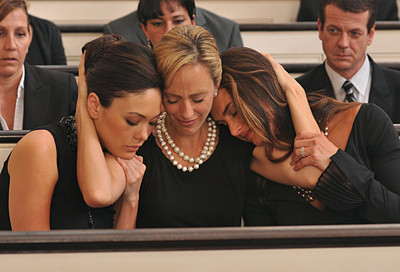
Nico, Victory, and Wendy Crying
 Image from: tvfanatic.com
Image from: meningitisuk.org

The two pictures above are photos I found on google image. Which better represents how you would like to be sent off? Personally, while my family and friends will ultimately decide, I would much rather the second image, a celebration of my life instead of a mourning ritual. Clearly, grieving needs to happen, but maybe this is best dealt with after the closure of a "happy ending" and the funeral should stick to what the deceased themselves wanted. Maybe being put on marionette strings is pushing it a little, but I like the general idea behind it. When my friend put it out there, my response was that I would like to have my picture put on a life size cardboard cut-out. That way, I can join the party without freaking anyone out too badly!

Wednesday, March 16, 2011

Earthquake in Japan

The recent events in Japan have had me following the news closely, with both awe and sadness. The huge earthquake and tsunami absolutely wreaked havoc on the coast and left nothing but devastation. And the death toll continues to rise. It saddens me to think in these terms, but it's also an interesting comparison: given the reading we did early in class on the earthquake in Bam, will we see similarities in changes of burial patterns/styles in Japan after this disaster?

http://www.abc.net.au/news/events/japan-quake-2011/beforeafter.htm

I was unable to put a direct copy of the images into my blog, but the link above goes to a page that shows "before and after" aerial shots in various locations. It seems impossible that anyone could have survived, and it is a miracle and blessing that so many did. Among the wreckage, though, it is inevitable that many were lost. The upheaval (not just physical, but economic, social, political etc.) caused by this earthquake has likely created a situation where there are many people to be buried, with little space, time, or money to do so. This is where I see the parallels to the earthquake in Bam. There, burial patterns changed in response to these upheavals, and the survivors found new and creative ways to honour and respect the dead. I am not familiar with current burial styles in Japan, but I imagine they will be changing, and that these changes will be visible in the archaeological record. It may include changes in burial placements, kinship arrangements, or style/type of tombstone.

I hope that this blog is not too soon, and that no one is offended by my analysis of the recently deceased. I have kept it short to be respectful, and only propose the idea as something to keep an eye out for from an archaeological perspective.

Garazhian O., Papoli Yazdi, L. (2008) Mortuary practices in Bam after the earthquake: An ethnoarchaeological study. Journal of Social Archaeology, 8 (1), pp. 94-112

Sunday, March 13, 2011

Kinship

Kinship, no matter how you define it, is an incredibly important part of a person's life. It doesn't matter if it includes family, friends, or the whole community, having a group of people to love and who love you back can make an enormous difference to a person. That's why, when I was reading the blogging prompt about identifying kinship in our monument analysis, I got thinking about the implications of kinship in death.

For the majority of our sample, there was no evidence of a link between burials, except for the case of two twins. One had died as a child and was buried in the early 1900s. The other twin apparently lived a long life, and was subsequently buried next to his brother. The burial plot is relatively small, and re-digging to put the older twin in must have been planned in advance. Also, the headstone appears to be new. These changes to the grave show a clear and deliberate choice to maintain family ties even after death. What does this say about that particular family's belief in an afterlife? Was this choice a pragmatic one, based on the plots held in the cemetery? Or was it more for the sake of the remaining family, reuniting the brothers to ease the pain of loneliness and grief? Yet the parents or other siblings didn't appear to be buried anywhere nearby, so why are just the brothers together? The photo below is taken from our memorial analysis, and is the headstone of the grave. It shows the names and dates of the brothers, as well as the newness of the tombstone.


IMGP0072

Perhaps this piqued my curiosity so much because my own grandparents were buried in a similar way. My grandfather died many years ago, before I was born. When my grandmother passed away, only about 5 years ago, she was laid to rest right on top of his coffin. Despite never having met my grandfather, it was immensely comforting to me to know that grandma wouldn't be alone in death, or even just where her physical body was. I am not a religious person by any standard, and I don't actually really believe in an afterlife. Yet, with this death, the first I had ever experienced, I found myself easing my pain with that exact notion. To this day, years later, I still use the idea that I might somehow "see her again", or that "she is in a better place" to avoid the sadness that comes with remembering her. This fascinates me, as I'm completely aware that I'm doing it, and that I don't believe what I'm convincing myself of. It's quite a complicated train of thought and I avoid digging into it as much as I can!

To get back to the twins in our case study, and with this personal experience in mind, it seems more likely that they were buried together for the family's sake rather than their own. Seeing as one brother died at such a young age, it is unlikely that the older twin remembered much about him or had a strong connection. I do not mean to diminish the grief he and his family must have felt at the loss in any way. I'm quite sure that even the knowledge that he lost his brother so early in life must have had an influence on the older brother's experiences. However, given the circumstances and time gap, it seems reasonable to me to assume that the joint burial was for the sake of the family rather than for the "comfort" of the twins. Perhaps the lack of other kin nearby was an indication of how important the remaining family felt it was for the twins to be reunited - maybe this was for the younger brother, rather than the older. Interestingly, as I discovered in my own experience, it may also have nothing to do with a religious belief or affiliation. There is no way of knowing for sure, but whatever the case may be, I think it is very interesting, and the parallels to my own experience make me very curious about the various ways in which the living bury the dead to comfort themselves.

Sunday, February 27, 2011

Bunny Mummies

Over reading break, one of the last things on my mind has been death. I have found it hard to come up with blog ideas while relaxing and reading? And I certainly hadn't managed to come up with anything interesting until this morning. During breakfast with friends and family, the UVic bunny issue came up. Even though we are all unsure as to what exactly happened to the majority of the rabbits, it's quite clear that most were sent to the big bunny farm in the sky.

In the case of UVic, the rabbits are a pest that are destroying the land and causing millions of dollars of damage every year. It is quite a dilema though, because as has been proven true, you can't get away with simply killing them off. And clearly, giving them away didn't work out so well for some of them either. This got me thinking...is there any way we could cull the UVic rabbits without upsetting the bunny activists? I did a bit of research and here's what I found.

Dr. Salima Ikram, of the American University in Cairo, has been researching Egyptian methods of animal mummification. The ancient Egyptians worshiped animals as incarnations of the gods, and therefore their mummification was very important and precise. I find this approach to animal death very interesting, and see some parallels today (for example, many people have their pets cremated and keep the ashes on their mantle. Some even use taxidermy to keep their pets "alive"). Although my reasons for suggesting bunny mummies at UVic are slightly different, I think it's an intriguing idea!


I imagine it is a rather expensive procedure, but it can't be too much more than the cost incurred by bunny damage every year. If we were to mummify the UVic rabbits, perhaps the bunny activists would see that the rabbits are being respected, but the problem would still be eliminated. I'm not too sure what to do with the rabbits after mummification though....it could get quite creepy.

I realize this is a somewhat morbid and cynical post, but I can assure you I am the absolute farthest thing from an animal-hater. In fact, I have spent several months doing volunteer work in animal conservation! But if there has to be death involved with the UVic bunny situation, morbid as it may be, I think bunny mummies might just satisfy everyone involved.

Wednesday, February 9, 2011

Memorial Monument Analysis

A Survey of Children's Graves


View Naked and Beheaded: A Survey of Roman Catholic Childrens' Graves in a larger map

1. This data set of this survey includes 11 children's graves in Ross Bay Cemetery, Victoria BC (see map). Although there are 12 burials associated with the 11 monuments, one headstone stands for twins, only one of which died as a child, and we therefore did not include the older burial in our study. To eliminate broad conflicts  of style and distribution, and to effectively shrink our sample to a manageable size, we selected only the graves of children under 10 years old in the south easternmost corner of the cemetery. However, we recognize that in analyzing only one specific section, there is an inherent limitation in interpretation and comparison within the cemetery. The small sample size and analysis using a single cemetery is also problematic, reducing a much larger mode of cultural expression to a very modest representation. Given the scope of this assignment, however, we feel that we made the best choices available to perform a comprehensive study.

2. Our research focused on two main questions: What is the variation (distribution, style, alignment, and weathering) among the graves?, when were the children buried?, and can this information tell us anything about life in Victoria over the time represented in our sample?

3.  The analysis of our data set, consisting of 11 child burials in the Ross Bay Cemetery, was effective in answering our research questions. According to the Old Cemetery Society of Victoria's website, this south eastern corner of the cemetery hold Roman Catholic, Anglican, and general burials. Given the time period of burials and the broader cultural influence of the time, as well as the conformity of the section, it is reasonable to assume that even most general graves were of a Christian denomination. Despite a lack of outside sources of information, we found some consistencies in burial type over time, suggesting a continuity of Christian religious thinking. We also found some variation in the number and distribution of graves that appear to be related to certain time frames and broader social circumstances.

Consistencies in burial practice were most pronounced in the analysis of grave alignments - all graves surveyed were aligned East-West, although there was no apparent preference for which direction the individual was facing. As discussed in class, this directional orientation is typical of Christian internments. The decision of east or west facing appears to have been based on the layout of the cemetery, and respect for the pre-determined organizational rows. In agreement with Deirdre Crombie's analysis of nineteenth century Catholic child graves in the Barony of Dunmore, however, despite great variation in the size, weathering and location of the graves, many had a clear burial demarcation of stone (rectangular), filled with earth and containing the grave-marker (Crombie, D. 1988). In our analysis, 6 graves had a stone boundary (others had boundaries of other materials, see map), 10 had an earthen surface, and all had a grave-marker (see map). This comparison shows remarkable Christian religious burial practice continuity over continent and century. With this in mind, I interpret much of the variation (weathering or upkeep/replacement of the headstone, type of headstone and grave, etc.) to be the result of individual choice, while keeping within the acceptable practices.

In a more socially-based approach, it is interesting to note that 7 of the children were buried between 1917 and 1937, 2 were buried in the 1990s, and the remaining 2 graves were not dated, although they appear quite old, being very weathered (see map; example, Mary Planche). The large portion of graves from the early twentieth century could be due to a number of factors; World War I; the depression; general poor population health; and the age of the cemetery. According to Guyard et al.'s article on changing population health (which is closely related to social factors such as war and depression), in the early 1900s, the child (from 1-20 years) mortality rate  was nearly 3%, which is extraordinary high in comparison to modern rates in developed nations (Guyard, B. et al. 2000). Given these influences, I hardly find it surprising that the majority of the child burials fall in this time period. This is a factor that would affect all groups, not just Christians, and we would expect to see similar effects aspects of the archaeological record for populations of any culture. For example, it may be the case that the variation in gravestones is due to differences in wealth which would be more pronounced in times of hardship. Another interesting point, is that the grave of Robert David Player is separated from the rest of the children's graves by a section of war burials. This, I believe, is further indication of an outside social influence at the time of death.

In conclusion, our survey effectively answered our research questions. We found continuity in the East-West alignment of the graves, and to a certain degree in distribution (even spread except for the war burials). However, both style and weathering were highly variable, showing a level of personal choice in the burials. As the large majority of the children surveyed died and were buried between 1917 and 1927, it is reasonable to imply the hardships of war and poor health standards as a factor in this large percentage of childhood deaths, while taking the age of the cemetery itself into account. While these social aspects of life, and subsequent improvements, are visible in these monuments, I believe that a broader survey would show similar effects for all groups at the time.

Work Cited
Bernard, G., 2000. Annual Summary of Vital Statistics: Trends in the Health of Americans During the 20th Century. In: Pediatrics, 106(6), p.1307-1317.

Crombie, D., 1988. Children's Burial Grounds in the Barony of Dunmore: A Preliminary Note. In: Journal of the Galway Archaeological and Historical Society, 41, p.149-151.

Old Cemetery Society of Victoria, no date. Ross Bay Cemetery: Sections [Online] (no date) Available at: http://www.oldcem.bc.ca/cem_rb_sec.htm [Accessed 10 February 2011].
Monday, February 7, 2011

Field Trip Consequences

This weekend, my group got together to do our field work portion of the monument analysis assignment. We were working in Ross Bay cemetery, on a beautiful sunny day. As we were walking around in our various bright colours, talking, and taking photos and notes, it got me thinking about the proper etiquette of graveyards.

I felt somewhat out of place as a few people in black walked by...by being there for a project, and not to pay my respects, was I being disrespectful? Despite having no personal connection to any of the people buried there, I still found myself walking around the grave markers, being very careful not to step on the actual burials, taking a look at all the graves I passed, and apologizing in my head if I happened to break these rules I had. And despite being somewhat tempted to look beneath cracked gravestones, I didn't, thinking that doing so would be completely unacceptable.There was also a definite mood that set in over the course of our analysis, one of a quiet, peaceful exploration, rather than a search for certain "specimens". Why do graveyards affect us this way and why do we, as individuals rather than a culture, treat the dead the way we do?
IMGP0095 by naked&beheaded
Our group at Ross Bay Cemetery - are the smiles too much?


This is, of course, a question without one single answer. Decades of cultural integration, change, and pragmatic decisions have influenced our behavior. We learn from our parents and take these lessons and make them fit with our own personal views. It seems like a lot of practice must go into this kind of code. But I have only ever been present at one funeral, and the only other graveyards I have visited have been on walks through historic churches or other similar situations. So I found it kind of funny that I had such a strong reaction, wanting to follow the "proper" etiquette in Ross Bay cemetery.

The emotional experience of being there also gave me a new perspective on the practice of archaeology. Being an anthropology student (and taking a class on death), I have obviously been exposed to many burials, burial practices, excavations, explorations, etc etc etc. Until Saturday, however, I found it hard to think of the individuals uncovered in excavations as people, with names, families, and a whole history of life behind them. Ross Bay showed me that it is actually very possible to have a connection to burials, even if they are very old. Having personally felt those connections, I feel that I now have a much better appreciation for the moral dilemmas associated with archaeology and the complex understandings involved in decisions and negotiations with other culture groups (like excavations of First Nations graves, for example). I guess now I have a personal conflict about whether or not excavations are the right way to discover the past - I love the information that comes out of excavations, but it is so important to understand the culture and their practices before we go and dig everyone up, to make sure that it would be somehow "ok" with them. And then, of course, this is a catch 22. How can we know anything about them if we have nothing to study?

I guess I've just now caught on to a debate that has been going on for a long time. I doubt I'll be the one to answer any of these questions, but I feel better now that I am able to fully comprehend both sides. Maybe it will make me a better archaeologist, or maybe it will make me quit, but either way, it is an interesting struggle that has really managed to dig itself into my brain!

Wednesday, January 26, 2011

Hanging Out Forever

As I started thinking about new and strange ways to be buried, I found I was having trouble coming up with anything that I would actually want for myself. I'm a sucker for tradition so I find it hard to break from the established norm for these types of things without a good reason. Sure it would be neat to be made into a diamond, but that would also be a little bit creepy...I know I wouldn't want to wear my grandma, so why should I impose myself forever on someone else? Being shot into space would be neat I guess, but no one could ever visit me again. Mummification surely isn't for me. Cryogenics doesn't work.

My resounding "NO" to all of these funerary practices got me thinking about the limitation and requirements I seem to have for my own burial: 1.I want to be accessible, in one way or another, to my family and friends left behind. 2. I want to remain whole. I'm not sure why, but I feel like staying in one piece might be a good idea. 3. I don't want to be present in everyone's life at all times...distance from the dead is a good thing (in my opinion) so I would like to be separate from everyday life.

With these guidelines in mind, I began searching the internet for something original that might suit me. And lo and behold, it didn't take long until I ran across somethings awesome...the hanging coffins of Bo! Although this practice is not new, being used by the Bo people of China for centuries, it is definitely not something you see everyday. This practice involves placing the dead in a coffin, and attaching that coffin to the side of a prominent cliff.

The dead are therefore displayed to the living, yet separate from their lives, and left in one piece. I like this burial method because it seems adventurous even in death. I'm not a religious person so I have no particular specifications that say I can't be put to rest on the side of a cliff. So why not? It is somewhat of a spectacle, taking the weight off of the tragedy of death and re-contextualizing it in a unique and (in fear of being insensitive) somewhat goofy way!
hanging coffins of bo
From: 7 Strange Funeral Customs from "Weird Worm":
http://www.weirdworm.com/7-strange-funeral-customs/
This funerary practice wouldn't leave much in the archaeological record. The coffins are wooden, and they are driven into the cliff face with wooden spikes. After many many years, the only evidence that I was ever there would be the holes in the stone where my coffin hung. This is another reason I like the hanging coffins of Bo. Not only is it entirely biodegradable and environmentally friendly, but leaving such a strange mark in the landscape would puzzle archaeologists down the road and I like to think it would be my last joke. I wonder what they would come up with to explain those holes. Birds? Rock climbers? Some strange ritual test of accuracy and strength? Who knows what theories I could spark!

Thursday, January 13, 2011

My own grave goods

 If I were to die today, what would I want my family and closest friends put into my grave? What a weird thing to think about. I suppose that when someone dies, they want their loved ones want to remember only the good things about them, and all the positive and happy moments in their life. So that eliminates a lot. But I've had a very happy and exciting life, so it will be hard to pick! Ok, top three things that I would want with me six feet under:
1. A memento from my trips to Africa - Altogether, I have spent almost 5 months on the continent, and it has truly changed me to be a more confident and caring person. It also helped me direct my life, inspiring my goals to work in international aid. Those people who know me well know what I never stop babbling about how much I love Africa and how much I want to go back! They also know that who I am now, after my travels, is better than who I was before I left. So I would want something to reflect this positive change and the adventurous, compassionate and always-looking-for-a-challenge side of myself!
2. Books that have been compiled for both sides of my family by my siblings, cousins and myself for our grandparents and families. I am far too close with my family for my own good. They are a major part of my life and they got me to where I am today (dead, in this case...). My family is where I've had some of the best times of my life and spent some of my happiest days. Seeing as being dead will be a new experience for me, I think it would be nice to have some of this comfort down there with me.
3. Last, but not least, I would want to be buried with various gifts I have received from my friends over the years. These all show a positive and loved side of myself and the good times I have had with some fabulous people. The people you associate with are a reflection of yourself, and I would be proud to be remembered as one of them!
All of these things reflect the positive side of me. I would want to be remembered for the things I did right, and the people I have loved, and not for anything else. They also let me toot my own horn right down to the last - and why not go down singing?

Thursday, January 6, 2011

Intro

Hi everybody!
My name is Emily and I'm a fourth year anthropology student. I wanted to take this class because, well, it's interesting. I took Viking archaeology last semester and loved the layout of the course, and as this one is with Dr.McGuire too, I thought I'd give it a shot. And so far so good!